How Many Times Can You Sit the ADC Practical Exam?
The short answer: there is no official limit on attempts. But in practice, the number of times you can sit the practical exam is capped by time, not by rules. Your written exam result is valid for five years (three years if you passed before March 2026), the ADC runs only three practical examination periods per year, and you cannot sit two periods in a row. Add realistic preparation time, and the window leaves room for only a handful of attempts.
Here is how the arithmetic works, and what it means for your planning.
There is no attempt limit — but there are three clocks
The ADC does not limit how often you may attempt the practical examination. What limits you is validity:
- Your written exam result. If you pass the written exam from March 2026 onwards, your result is valid for five years. If you passed in 2025 or earlier, the old three-year validity still applies to you — the extension is not retroactive.
- Your initial assessment. It is valid for seven years and renewable before expiry. The renewal itself is simple: a form on ADC Connect and a $35 fee. But you may need to arrange a new certificate of good standing from your dental registration body at home — which means you must keep your home-country registration active, even if you have been living in Australia for years. And do not let the initial assessment itself lapse: if it expires without renewal, the ADC requires you to "start the process afresh and any previous successful exam results will be void."
- The calendar itself. The ADC runs three practical examination periods per year, and "candidates cannot sit consecutive practical examination periods." Each period follows the same rhythm: you apply during a short application window, select your preferred exam date in a second window a few days later, sit the exam during the examination window some months after that, and receive your results about six weeks after your exam date.
Together, these clocks — not any attempt limit — decide how many chances you get.
Why you probably won't sit the first available period
On paper, you could apply for the first practical period after your written pass. In reality, very few candidates do.
The practical exam requires a different kind of preparation than the written. Most candidates set up a home practice station with a phantom head and typodonts, take a refresher or academy course, and build up their spoken OSCE performance for the clinical skills day. That takes months.
There is no official data on how long candidates prepare before their first sitting. Prep providers commonly suggest around four months of full-time preparation; for candidates preparing part-time alongside work, six to twelve months is common. Treat these as rough guides, not rules.
If you are running out of time, the ADC moves you forward
The application system is built around expiry pressure. Each period opens in two stages: Stage 1 is reserved for candidates whose initial assessment or written exam expires soon; everyone else applies in Stage 2, first come, first served. If this period is one of your last chances, you apply first.
There is also a waitlist. When candidates withdraw, seats open up — usually at short notice — and "priority will be given to candidates who have not sat a practical examination within the previous examination period." You are not obliged to accept a short-notice seat, and you should think before you do: the ADC notes that "no special consideration can be given if they choose to sit at short notice."
A realistic timeline: the five-year window
Suppose you sit the written exam in September 2026 (it runs 16–17 September). Using the ADC's published period dates, the window looks like this:
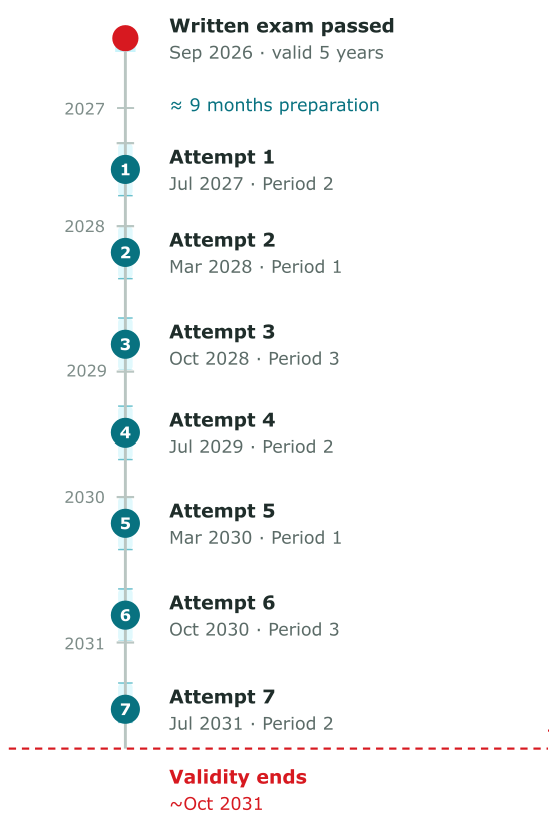
Your results arrive about six weeks after the exam, in late October 2026, and your pass is valid until about October 2031. After roughly nine months of preparation — home practice setup, a refresher course, spoken OSCE practice — you apply in February 2027 and sit your first attempt in July 2027, during Period 2. If it is unsuccessful, results arrive in mid-August, Period 3 2027 is blocked by the no-consecutive-sittings rule, and your next chance is March 2028, in Period 1. From there the rhythm repeats, one attempt every second period: October 2028, July 2029, March 2030, October 2030, and finally July 2031, just before your validity runs out.
Near the end of the window the rules bend in your favour — as an expiring candidate you apply in Stage 1, and a waitlist seat may even allow consecutive periods for a final attempt; candidates have reported the ADC helping them into a seat in the very next period. But expect that route to be tight: offers come at short notice, preparation time shrinks to weeks, and the ADC gives no special consideration for sitting at short notice.
On paper, that is up to about seven sittings. Whether you can use them all is another question: each attempt costs $4,775 plus travel to Melbourne, seats are not guaranteed, and preparing again after an unsuccessful attempt takes time. The ADC does not publish data on how many attempts candidates actually make.
The same example with the old three-year window
If you passed the written exam in 2025 or earlier, the three-year validity still applies. Same candidate, one year earlier:
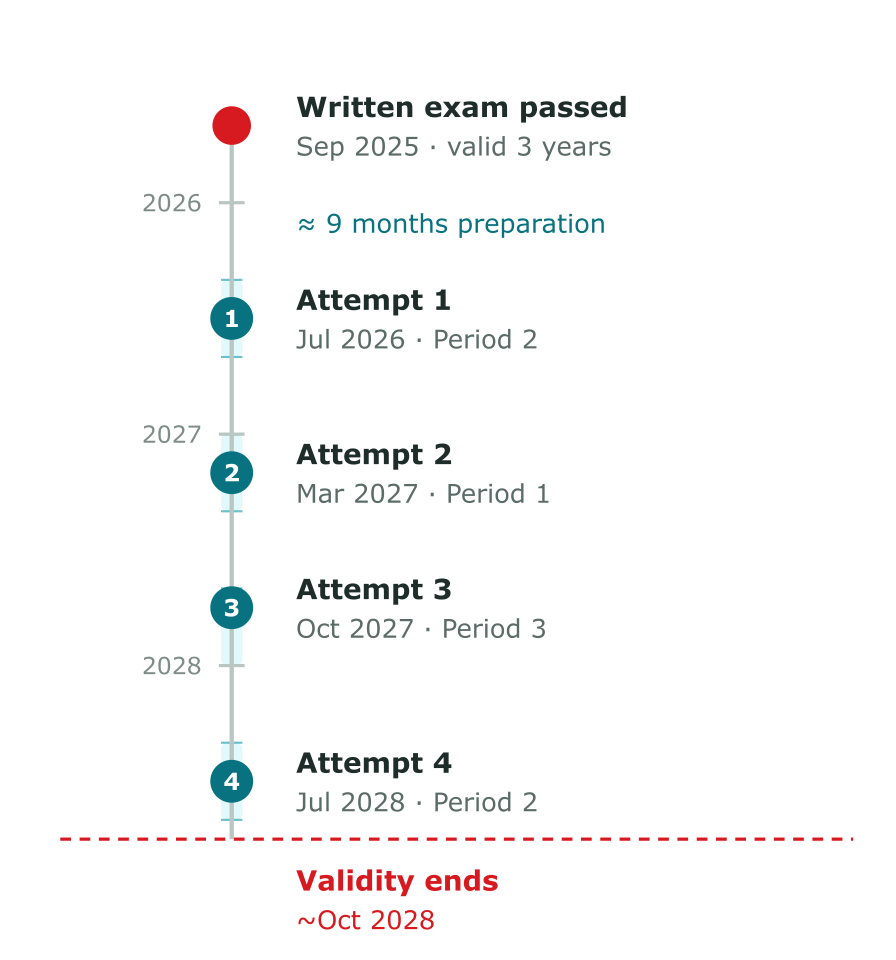
The picture is the same, only shorter. You pass the written exam in September 2025, valid until about October 2028. Nine months of preparation put your first attempt in July 2026, during Period 2; an unsuccessful result in mid-August blocks Period 3, and the alternating rhythm leaves March 2027 (Period 1), October 2027 (Period 3), and July 2028 (Period 2) — the last window before your validity ends.
Four sittings on paper. With any slip — a missed application window, a waitlist, extra preparation time — it drops to two or three. This is why "no attempt limit" is technically true and practically misleading: the calendar is the limit.
What this means for you
Plan backwards from your written exam expiry date, not forwards from today. Count your realistic attempts — for most candidates that number is smaller than expected — and treat each one as scarce. At $4,775 per attempt plus travel to Melbourne, and with each unsuccessful sitting consuming not just one period but the next one too, the cheapest attempt is the one you are properly prepared for.
And keep the third clock in view: renew your initial assessment before it expires. It is a small administrative step, and forgetting it voids everything you have passed so far.
Sources: ADC — Practical examination; ADC — Written examination validity extension (The Candidate Lounge, December 2025); ADC — Initial assessment; ADC — 2026 Period 3 application stages; Academically — preparation guidance.