
ADC Single Station Scoring Explained
When you finish a station in the ADC practical examination, the examiner has recorded two separate things about your performance: a checklist score and a global rating. They are not two versions of the same mark, and one is not added to the other. They do different jobs.
Here is the whole story in one sentence:
The checklist gives you a numerical score. The global ratings given across the whole candidate group are used to help calculate the passing score for that station.
The rest of this article unpacks that sentence.
Two Different Assessments
Think of the two assessments as answering two different questions:
- The checklist asks: "How well did the candidate perform each specific part of the task?"
- The global rating asks: "Looking at the performance as a whole, how competent was this candidate?"
Your result at the station comes from comparing your checklist score against a passing score (the "cut score"). The global ratings are the main ingredient in working out where that cut score sits.
The Checklist Score: 0 to 45
Each OSCE station is scored across 15 checklist criteria — specific things the examiner is looking for. (ADC's general wording is "up to 15 criteria" per task; its published OSCE worked example uses 15.) For each criterion, the examiner awards one of four grades:
| Rating | Score |
|---|---|
| Very good | 3 |
| Satisfactory | 2 |
| Borderline | 1 |
| Unsatisfactory | 0 |
Your checklist score is the sum of your 15 criterion scores. The lowest possible total is 0 and the highest is 45.
A worked example.
Here are the checklist criteria defined for the "Diagnosis and Management Planning" clinical scenario with example scores.
| # | Criterion | Score |
|---|---|---|
| Underlying knowledge | ||
| 1. | Signs and symptoms identified and discussed | 1 |
| 2. | Appropriate treatment is offered, both immediate and long term | 2 |
| 3. | Displays knowledge of the pathophysiology of the diagnosis | 1 |
| 4. | Displays knowledge of the principles of the specific treatment | 1 |
| Clinical reasoning and management | ||
| 5. | Treatment plan is comprehensive | 2 |
| 6. | Modifying or risk factor explained: smoking | 1 |
| 7. | Modifying or risk factor identified and explained: family history of tooth loss | 1 |
| 8. | Modifying or risk factor identified and explained: OPG shows alveolar bone loss | 2 |
| 9. | Modifying or risk factor identified and explained: clinical signs of periodontitis, including deposits, bleeding on probing, probing depths and recession | 1 |
| 10. | Appropriate recommendation for further investigation: referral to a periodontist | 3 |
| 11. | Diagnoses the pathology | 0 |
| Communication | ||
| 12. | Builds a relationship | 1 |
| 13. | Gathers information | 2 |
| 14. | Understands the patient's perspective | 1 |
| 15. | Shares information | 1 |
| TOTAL | 20 |
Here is the critical part: 20 out of 45 does not, by itself, tell you whether the candidate reached the station standard. There is no fixed passing score such as "50%" or "you need 22." The passing score is calculated separately for each station — and that is where the global rating comes in.
The Global Rating
Alongside the checklist, the examiner gives one overall global rating for the whole performance, choosing from five categories:
- Outstanding
- Pass
- Borderline
- Fail
- Bad fail
Note that "Borderline" here is a different thing from the Borderline checklist rating — one applies to a single observation, the other to the whole performance.
The global rating is a holistic professional judgement with a specific reference point:
Does this candidate reach "the standard expected of a newly qualified Australian dentist"?
That is the benchmark ADC states for the examination. What ADC does not provide is a clear definition of what that standard looks like in practice — there is no published description of exactly which behaviours place a performance at, above or below it. The examiner applies the benchmark using their professional judgement.
So where the checklist rewards individual pieces of the task, the global rating captures whether the pieces added up to a competent whole, measured against that new-graduate benchmark.
This distinction matters. A candidate can mention many correct points and collect checklist marks, yet still come across as disorganised, clinically confused, unsafe, overly rehearsed, unable to adapt to the patient, or unable to connect the information into a coherent consultation. The checklist may not fully capture that; the global rating can.
How the Global Rating Calibrates the Passing Score
So if the global rating is not added to your score, what is it for?
Its main statistical role is to help set the passing score for the station, through a method called borderline regression. The idea: rather than someone deciding in advance that "28 out of 45 is a pass," the passing score is derived from how the whole candidate group actually performed.
ADC calculates the station pass mark using results from a group of candidates who completed the same station. This group may include candidates from several examination sessions. In the worked example in ADC's Assessment Process document (Appendix 2), 36 candidates were pooled across three sessions held over two weeks. ADC has not publicly stated the exact group size or collection period it currently uses.
Borderline Regression, Step by Step
You do not need any statistics background to follow the method. The sequence is:
- Every candidate receives a checklist score (0–45).
- Every candidate also receives a global rating.
- The ADC examines how checklist scores relate to global ratings across the whole candidate group.
- Candidates with higher global ratings should, in general, have higher checklist scores.
- A straight line — a regression line — is fitted through the results, describing that overall relationship.
- The point on that line at the Borderline global rating gives a predicted checklist score, and that prediction is used to help establish the station's cut score.
To put global ratings on a number line, ADC's published coding is:
| Global rating | Numerical value |
|---|---|
| Bad fail | 0 |
| Fail | 1 |
| Borderline | 2 |
| Pass | 3 |
| Outstanding | 4 |
In ADC's published worked example — reproduced in the graph below — the fitted line predicts a checklist score of 23 at the Borderline rating, so 23 out of 45 became the cut score for that station.
Borderline Regression Graph
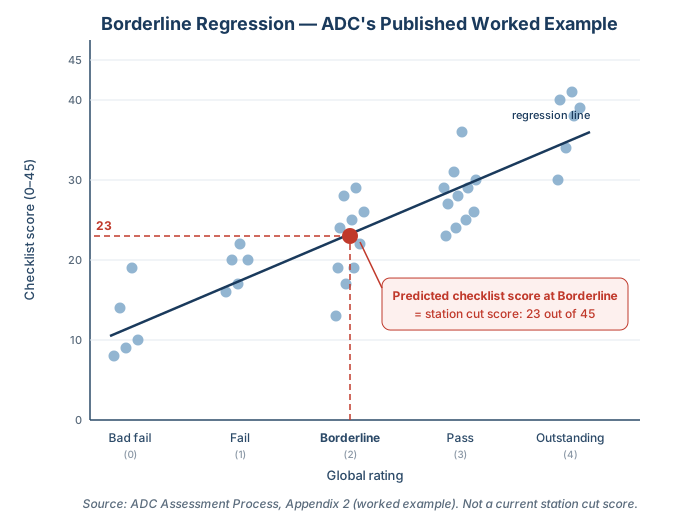 Data and cut score from the worked example in ADC's Assessment Process document (Appendix 2). It illustrates the method — it is not a current station cut score.
Three things to notice in the graph:
- Candidates with the same global rating can have different checklist scores — the dots at each rating level are spread out.
- The relationship is positive but not perfect — higher ratings generally mean higher checklist scores, but the dots do not sit neatly on the line.
- The cut score comes from the overall relationship across the group, not from any one candidate's result.
Why the Global Rating Might Feel Subjective
The global rating is a human judgement, so it carries an element of subjectivity. The ADC publicly identifies the five rating categories and the new-graduate benchmark, but its public material does not appear to include a detailed behavioural rubric defining exactly how an examiner arrives at a category or what separates the categories.
The ADC addresses this through examiner training, calibration between examiners, defined competency standards, and quality-assurance processes — all intended to reduce inconsistency, so that different examiners judging the same performance would land on similar ratings.
Common Questions
Does "Borderline" mean "just passed"?
No. Borderline means the examiner judged the performance to sit around the boundary between acceptable and unacceptable competence. It says nothing, by itself, about whether the candidate's checklist score ended up above or below the calculated cut score.
Does a global rating of Borderline automatically mean a pass?
No — and ADC's own worked example shows it. Ten candidates in that example received a Borderline global rating, with checklist scores ranging from 13 to 29. Against the cut score of 23:
| Global rating | Checklist scores | Against cut score of 23 |
|---|---|---|
| Borderline | 13, 17, 19, 19, 22 | Below — did not reach the station standard |
| Borderline | 24, 25, 26, 28, 29 | Above — reached the station standard |
Same global rating; different outcomes against the station standard.
Can a candidate rated Fail still have a checklist score above the cut score?
Statistically, yes, this is possible — the checklist and the global rating are separate assessments, so they can point in different directions for an individual candidate. (In ADC's worked example it happened not to occur: the Fail-rated candidates scored 16 to 22, all below the cut score of 23.) However, ADC does not publicly disclose enough detail to confirm whether a Fail or Bad fail rating, a critical safety error, or a moderation process can override the numerical comparison.
Am I ranked against the candidate group I am in?
No — there is no quota and no curve. The group's results are used only to work out where the pass mark sits for that version of the station, which is necessary because different sittings face different tasks, conditions and examiner scoring patterns. Once the cut score is set, you pass by reaching it, regardless of how many others do.
What ADC Publishes — and What It Does Not
ADC's public material describes: up to 15 checklist criteria per task (15 in the published OSCE example), criterion scores from 0 to 3 with broad descriptors for each of the four grades, a station total from 0 to 45, the five global-rating categories and their numerical coding, the use of borderline regression to set cut scores — including a full worked example with real-looking data and a cut score of 23 — trained and calibrated examiners, and the benchmark of a newly qualified Australian dentist.
ADC's public material does not disclose: current station cut scores, current regression coefficients, full examiner training materials, detailed behavioural anchors for each global-rating category, critical-error rules, moderation or override rules, or the complete statistical quality-control procedures. Where this article goes beyond the published material, it is labelled as interpretation or illustration.
The Main Point
The checklist gives you a numerical score from 0 to 45. The global rating is the examiner's overall professional judgement of your performance. Global ratings across the candidate group are used, through borderline regression, to help calculate the station cut score — they are not added to your checklist score. A Borderline global rating does not mean "just passed," and it does not automatically determine your result: what decides the station outcome is whether your checklist score reaches the calculated cut score.
Each station is scored this way on its own; station results are then combined into the overall examination result, which we cover in another article.